Last week, the Joint Oireachtas Committee on Fisheries and Maritime Affairs published their Pre-legislative scrutiny report on the Fisheries (Amendment) Bill. SWAN, our members and our recommendations are featured in the report, so in this blog we’ll take a look at what the Committee is and how we contributed.
A Joint Oireachtas Committee (JOC) is composed of TDs and Senators who work on a specific subject, allowing for more detailed examination of topics than might be possible within the Dáil or Seanad. These Committees can invite expert witnesses to their debates on particular issues to develop recommendations which can then be presented to the relevant Minister.
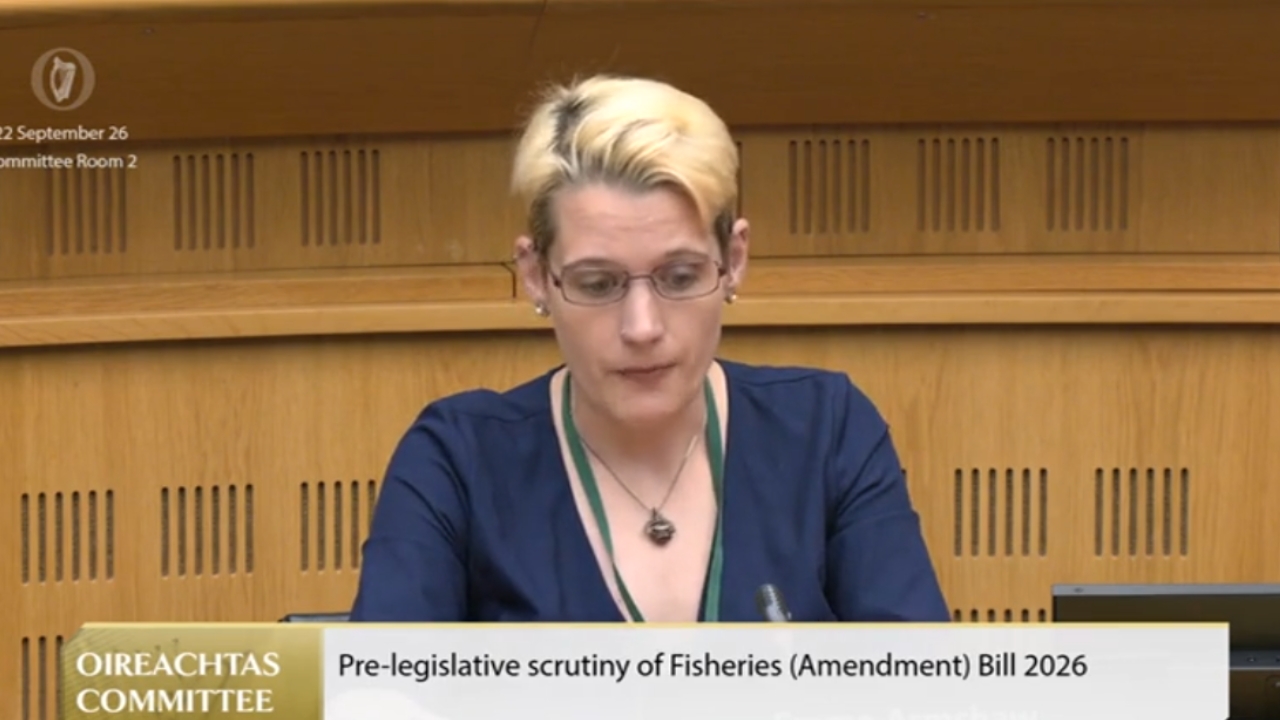
The Fisheries JOC invited SWAN to speak in two sessions in 2026– on aquaculture and water quality in June and on changes to aquaculture licensing through the Fisheries (Amendment) Bill in September. In addition to SWAN’s Marine & Coastal Policy Officer Emma Armshaw, we were joined by SWAN members Dr Elaine McGoff from An Taisce, Karin Dubsky from Coastwatch, John Murphy from Salmon Watch Ireland and Dolf D’hondt from Streamscapes. The range of expertise from our members ensured these Oireachtas members heard exactly how aquaculture is affecting nature, biodiversity and water quality, and what can be done about it. Other witnesses invited to attend the sessions on the Bill were from IFA Aquaculture, the Department of Agriculture, Food & the Marine, the Aquaculture Licences Appeals Board, Bord Iascaigh Mhara and the Marine Institute.
In the June session on aquaculture and water quality, we highlighted information from SWAN’s aquaculture policy paper, including studies on how open-net salmon farming impacts coastal ecosystems through pollution, marine litter, disease, parasites and escaped fish, examples of how mussel dredging can damage seabeds and the role of aquaculture in introducing alien and invasive species. We also discussed the recommendations developed by SWAN members. Our key ask is a ban on open-net salmon farming, as well as investment in research on restorative and regenerative forms of aquaculture.
The Committee then met to conduct pre-legislative scrutiny of the Fisheries (Amendment) Bill. Pre-legislative scrutiny is when the committee scrutinises the bill before it goes through the full legislative process. SWAN’s policy position included legal analysis of aquaculture licensing and recommendations of improvements, so these were presented to the Committee. After scrutiny of the General Scheme (effectively the first draft of the bill) published in August, our members were able to raise concerns with the Committee where environmental protections are missed.
One of SWAN’s legal recommendations was the repeal of Section 19A(4) which allows for the continued operation of aquaculture farms, even where their licence has been revoked. SWAN opposes the prolonged continuation of aquaculture operations after expiry of the original licence without a timely and effective environmental reassessment. While the General Scheme does provide for the repeal of Section 19(A)(4), it immediately reinstates it in Section 19(A)(2) and Section 19(B).
The JOC’s report states that there was “broad consensus among stakeholders that it is necessary to delete Section 19A(4) from the Act, in particular from Salmon Watch Ireland (a constituent part of SWAN Aquaculture) with whom the complaint to the EU regarding Section 19 originated. DAFM acknowledged that its repeal is a priority and stated its view that once this is done, it will bring the legislation into compliance with the EU Birds and Habitats Directive, thereby avoiding infringement proceedings, but also acknowledged that judicial review proceedings remain a live risk in the context of the removal of Section 19A(4).“
Regarding the insertion of Section 19B, the report also notes that “An Taisce states that Section 19(A)(1) is effectively reinstated in sections 19(A)2 and (B), with what An Taisce characterises as a ‘legally questionable’ qualification providing for the disapplication of this provision if the Minister deems that it has the potential to have a significant impact on the environment. An Taisce questions whether the Bill is therefore fully in compliance with the State’s commitments to full removal of Section 19(A)(4) under the Birds Case. It further notes that the Heads of Bill does not provide for the public participation obligations associated with determining whether or not an aquaculture.“
We welcome the inclusion of SWAN members’ concerns in the JOC report. Our point “SWAN was of the view that the legislation should explicitly require compliance with EU Laws and Directives and took the view that the language in the Act should be strengthened” is particularly important as we push to ensure nature is protected.
This report forms part of the government’s pre-legislative scrutiny of the amendment. There will be further opportunities to advocate for water quality and biodiversity as it moves through Committee stages. Keep an eye on SWAN’s emails and social media about how you can support. And make sure you sign and share our petition against open-net salmon farming, so we can show our representatives that the Irish public don’t want this industry in our seas!
Watch the full Joint Oireachtas Committee sessions here:
https://www.oireachtas.ie/en/oireachtas-tv/video-archive/committees/11802/
https://www.oireachtas.ie/en/oireachtas-tv/video-archive/committees/12037